

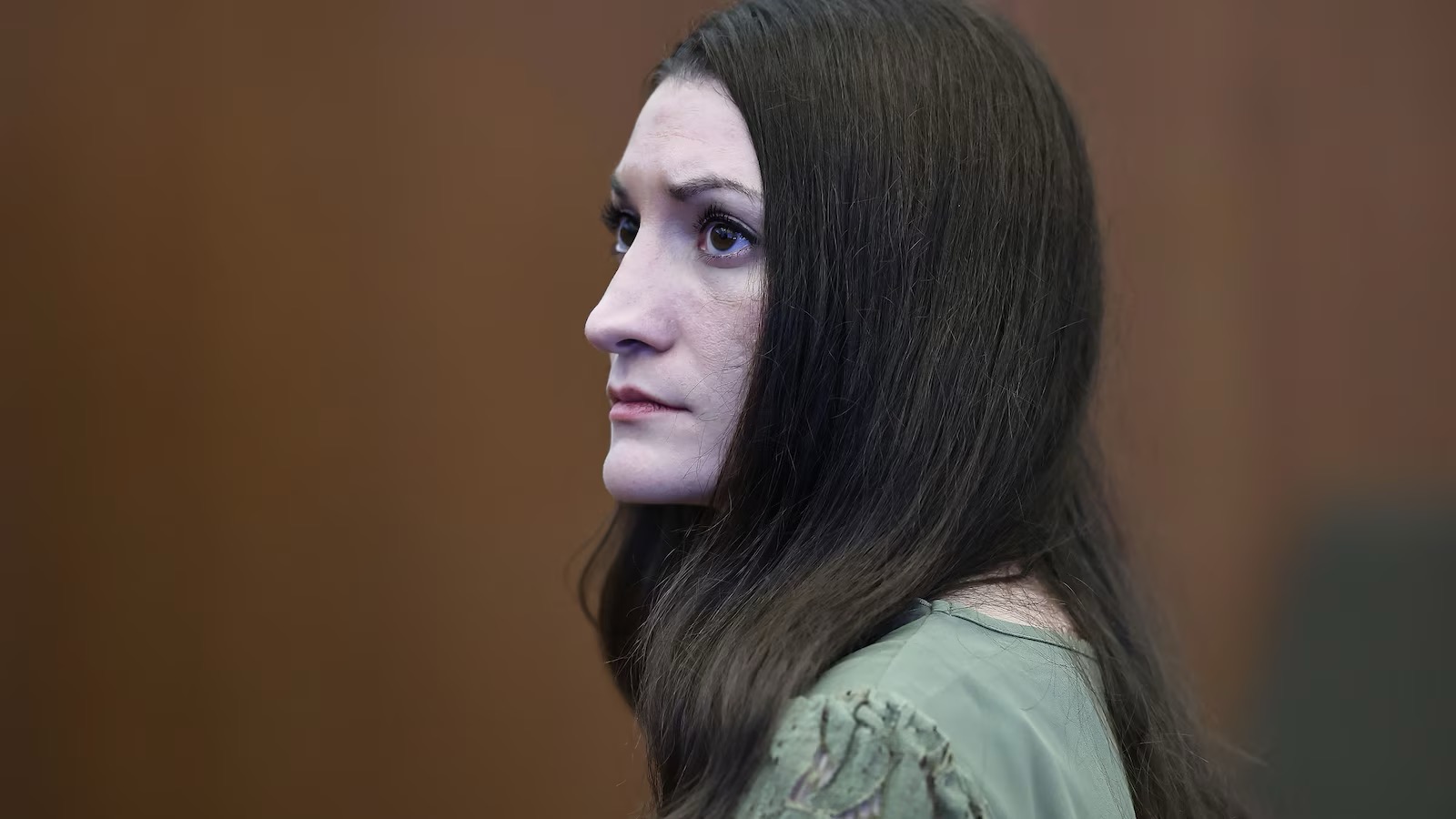
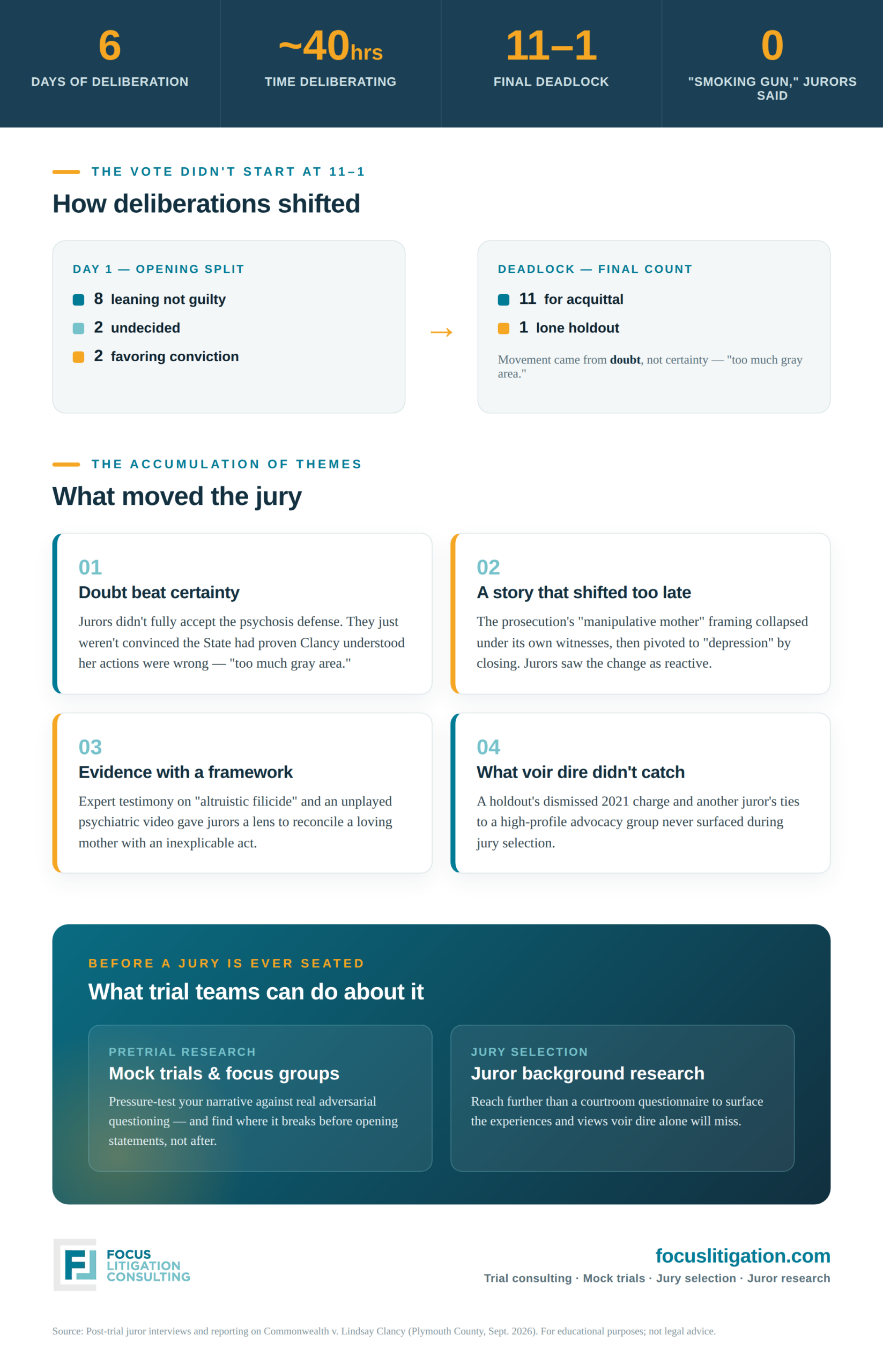
On September 4, 2026, a Plymouth County jury spent six days and roughly forty hours deliberating the fate of Lindsay Clancy, the Duxbury mother charged with murdering her three young children, Cora, Dawson, and Callan, in January 2023. It ended not in a conviction or an acquittal, but in a mistrial. Eleven jurors were prepared to find Clancy not guilty. One juror refused to join them, and the case ended in deadlock.
Post-trial interviews with several jurors offer an unusually detailed look at what actually moved eleven people toward that verdict. It was not one piece of evidence or one moment, but rather a slow accumulation of themes, which are worth walking through.
The Jury Didn’t Start at 11-1
According to juror Paula Devlin, deliberations opened with eight jurors favoring a not-guilty verdict, two undecided, and two favoring conviction. “We all worked together to convince ourselves,” Devlin said, describing the gradual movement toward acquittal. One juror, who began deliberations believing Clancy was criminally responsible, ultimately moved as well.
Her reasoning was not that any single piece of evidence had convinced her Clancy was unquestionably psychotic. Instead, it was doubt: “There was too much gray area,” she said, adding that prosecutors never produced a “figurative smoking gun.” Several other jurors described the same pattern: not full acceptance of the psychosis defense, just enough uncertainty that they could not say the State had proven its case.
That is worth pausing on. Because Clancy never disputed causing the deaths, jurors were not deciding whether she did it, only whether prosecutors had proven she understood it was wrong. Once several jurors settled on doubt rather than conviction as their basis for a not-guilty vote, that reasoning proved contagious.
A Narrative That Didn’t Survive Its Own Witnesses
In post-trial interviews, several jurors also pointed to a shift in how the Prosecution told its story. It opened by describing Clancy as manipulative and controlling, someone who wanted “a quick and easy fix” and had abandoned her own treatment. That framing did not hold.
The State’s own forensic psychiatrist conceded on cross-examination that it “really minimizes” what Clancy had experienced and a string of her own treating providers described fragmented, uncoordinated care despite her repeatedly seeking help. By closing arguments, Prosecutors had shifted to a different theory: that Clancy was depressed and had acted deliberately. Jurors said the change came too late, after the Defense’s witnesses, and several of the State’s own, had already left them with the picture of a devoted mother.
This is a powerful example of why developing a cohesive, well-delivered narrative early (and maintaining it throughout trial) is imperative. Jurors do not evaluate evidence in isolation; they use the parties’ competing narratives to organize the evidence and make sense of what they hear. When a party’s theory shifts significantly over the course of trial, particularly after evidence has undermined its initial framing, jurors may perceive the new argument as reactive rather than as the natural conclusion of the evidence.
Here, by the time the Prosecution reframed its case around depression and deliberation, jurors had already spent much of the trial processing the evidence through a very different lens. The lesson for trial teams is not simply to have a compelling story, but to pressure-test that story before trial, identify where the evidence or opposing witnesses are most likely to challenge it, and build a narrative flexible enough to absorb those challenges without requiring a fundamental change in theory. Pretrial research can be particularly valuable in determining whether the intended narrative resonates with jurors, where it is vulnerable, and whether the evidence actually supports the story counsel intends to tell from opening through closing.
The Evidence Jurors Kept Coming Back To
Two pieces of evidence repeatedly surfaced in post-trial interviews. The first was forensic psychiatrist Dr. Phillip Resnick’s testimony about “altruistic filicide”: killing driven by a delusional belief that death is an act of mercy. Jurors said the concept helped them reconcile two seemingly incompatible facts: a loving mother and an otherwise inexplicable act.
The second was a videotaped psychiatric evaluation of Clancy that was admitted into evidence but never played at trial. Jurors requested the video during deliberations, and Devlin said it left the impression that Clancy was delusional and did not believe she was doing anything wrong. One juror who had favored a first-degree murder verdict said the footage caused him to reconsider whether the killings were premeditated.
Both underscore the importance of giving jurors a framework for understanding complex or unfamiliar evidence. Dr. Resnick did more than offer a clinical opinion; he translated a difficult psychiatric concept into an explanation jurors could use to make sense of the case. Effective experts can be particularly valuable when jurors must evaluate conduct that otherwise seems impossible to understand.
What Voir Dire Didn’t Catch
None of this happened in a vacuum. Post-trial reporting revealed that the lone holdout juror had faced a domestic violence charge in 2021, later dismissed, that does not appear to have come up during jury selection. Separately, juror Kellie Farina, who voted to acquit, was identified afterward as an active member of the “Free Karen Read” Facebook group tied to another high-profile Massachusetts prosecution, with posts criticizing the lead investigator and prosecutor in that case.
Neither fact tells us how or why these jurors reached their decisions, nor does either necessarily establish bias. But both illustrate an important limitation of relying on voir dire alone. Jurors may not be asked about every potentially relevant experience, may not recognize that an experience is responsive to a question, or may have publicly expressed views that never surface in the courtroom. That is where comprehensive juror background research can add another layer to the jury selection process.